The Book
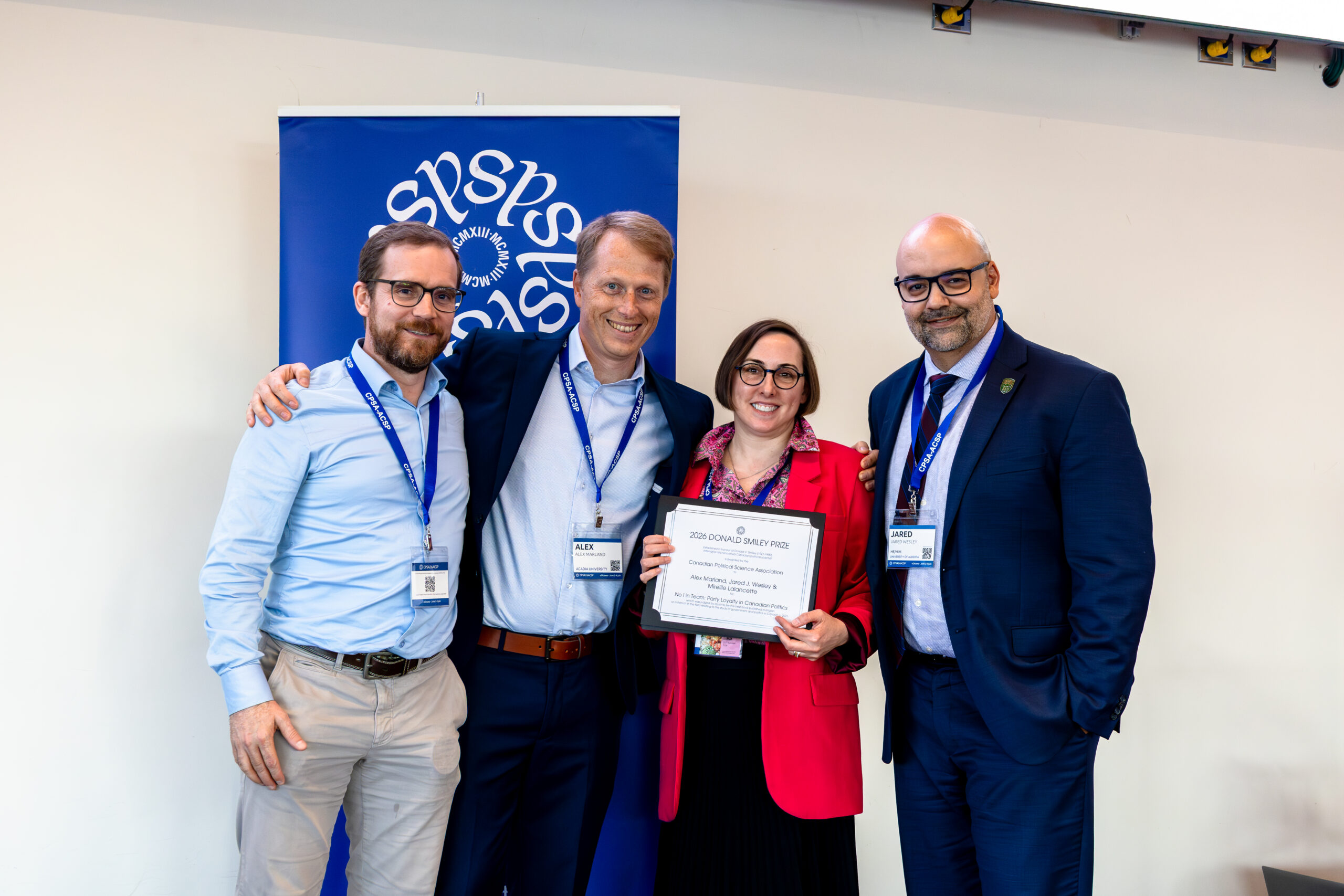
Congratulations to our three authors who have just won the American Political Science Association’s Seymour Martin Lipset Best Book Award for the best publication on Canadian politics in 2026! This recognition follows the gain of the Canadian Political Science Association’s Donald Smiley Prize for the best publication on Canadian politics and government earlier this year.
“No I in Team is a theoretically rich empirical analysis of the predominance of party loyalty over Canadian representative democracy. Marland, Wesley, and Lalancette illuminate the deep social and institutional origins of loyalty, its consequences for representation and democracy, and paths forward for recalibrating parliamentarians toward their role as delegates and trustees instead of brand ambassadors.” reports the jury of the Canadian award. And “The book illuminates the quiet mechanisms of anticipation and expectation that keep parliamentarians in line more often than formal sanction does, and it traces the costs of that discipline in the questions that go unasked and the constituents who go unheard.” writes the American Political Science Association about the book’s contribution.
More information on these two awards by following these links:
- Seymour Martin Lipset Book Award: https://connect.apsanet.org/s40/?page_id=14
- Donald Smiley Prize: https://cpsa-acsp.ca/prizes/2026-donald-smiley-prize/
Why are Canadian politicians so loyal to their parties? Why do most parliamentarians follow their leader’s direction and echo approved messaging, while so few rebel as mavericks or commit the ultimate act of rebellion by switching parties? And can anything be done to loosen the grip that party leaders hold over elected representatives?
No “I” in Team: Party Loyalty in Canadian Politics provides the first in-depth examination of the forces that shape party loyalty in Canadian federal and provincial politics, revealing how Members of Parliament and provincial legislators are conditioned to put partisan interests ahead of their constituents and independent judgement.
The authors show how institutional rules, political pressures, social dynamics, and digital technology have reinforced a system that demands unwavering loyalty. Drawing on extensive interviews with politicians and senior political staff, as well as an analysis of thousands of news stories spanning four decades, this book uncovers the evolution of party discipline into message discipline, where control over speech is as strict as control over legislative votes.
As political parties consolidate power and dissenting voices grow rarer, No “I” in Team raises urgent questions about the state of democratic representation in Canada — one of the world’s most stable democracies, yet one where elected officials increasingly act as partisans rather than delegates of their constituents or trustees of the broader public good.
Subject Categories:
Political Science (Canadian Politics; Political Behaviour; Political Culture), Canadian Studies, Political Sociology, Communications / Media Studies
Keywords:
Party Politics, Party Discipline, Canadian Politics, Party Loyalty, Partisanship, Party Switching, Parliamentary Democracy, Legislative Behaviour, Representation, Political Communications